Chargement de la carte…
 Joutes
Rechercher un jeu, une carte, un lieu, un événement…
CardNexus · relevé le 6 oct. 2026
prix bas 10,00 € · tendance 14,06 € · 8 oct. 2026
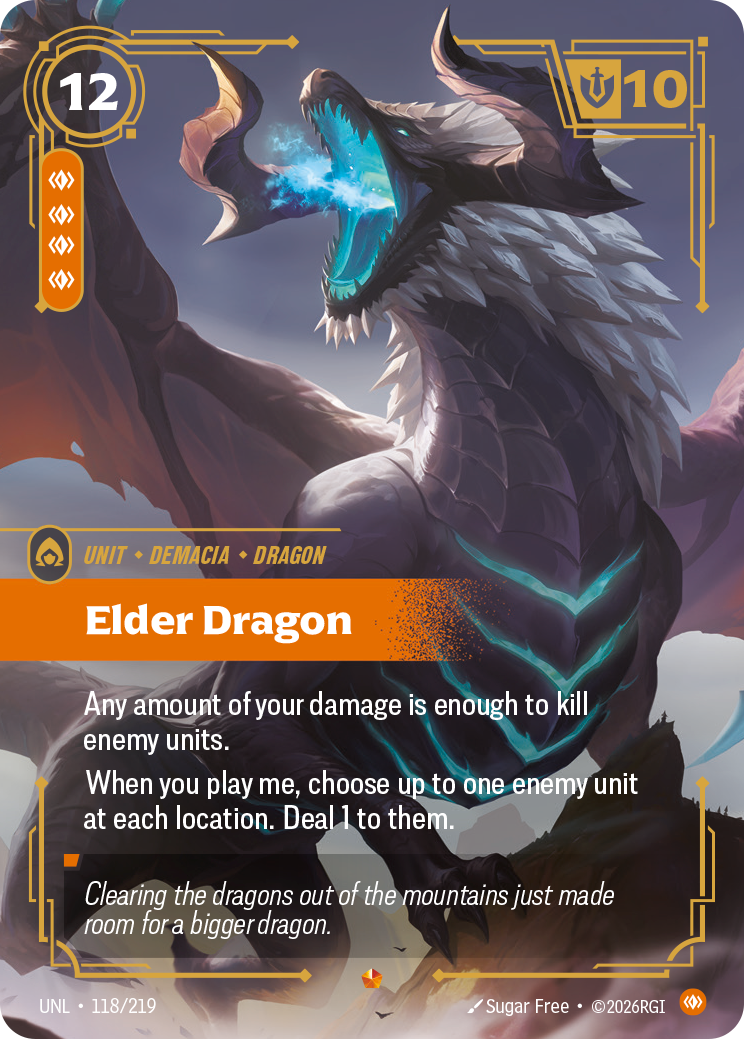
Any amount of your damage is enough to kill enemy units.
When you play me, choose up to one enemy unit at each location. Deal 1 to them.
Q. My enemy has a unit at a battlefield along with a hidden card. I play Flurry of Blades to damage the unit; it resolves. I then play Elder Dragon. Does my enemy get a chance to play their hidden card if it is:
If the two answers are the same, what are the exact steps for why? If the answers are different, why?
No.
Yes.
When Elder Dragon is played, its play ability triggers as a pending item. This now closes the state. We enter cleanup and check for lethal damage (323.5.). Because Elder has redefined lethal damage to 1 for their own damage, the damaged enemy units at the battlefield will die and there is no reaction window. HOWEVER, my enemy still retains control of the battlefield because we are in a Closed State (323.6.). Therefore, the hidden card continues to remain (323.7.).
After Elder Dragon play trigger is finalized (select targets), my enemy now has a priority window to react to Elder’s WYPM item with the hidden card.
Since Hidden Blade has no target, it cannot be played. However, a hidden unit like Tideturner can be played.
Q. I have an Elder Dragon in base. My enemy has a unit at Frozen Fortress.
It is now the beginning of my turn. Does their unit die? If it was the beginning of my enemy's turn, does their unit die?
A. The unit would live regardless of whose turn.
187.6.a. states that when you control a battlefield, then you control its abilities, and would be the one dealing the damage. In both instances, the enemy is controlling the battlefield so it is not "your damage".
Q. I have a unit at a battlefield with a hidden Zhonyas. My enemy plays Flurry of Blades; it resolves. They then play Elder Dragon (i.e. via Aurora). Can I save my unit?
A. The unit is unsaveable. When Elder is played, its passive ability is active and immediately kills every enemy unit with marked damage. As a result, no reaction would be able to save the unit.
Now, does the Hidden Zhonyas also get discarded? No! When Elder Dragon is played, its WYPM trigger is added to the chain as a pending item and we are now in a Closed state. So even if the unit dies from the battlefield, the player can still react to Elder’s item with the Zhonyas and put it to good use later.
My opponent plays Elder Dragon and targets my two units at the two battlefields, as well as one of my units in base. If I play Flash in reaction, moving the two units at battlefields to base, will they be dealt damage?
They will not.
Elder Dragon’s play effect has a number of targeting restrictions equal to the number of locations on the board. Its controller chooses up to one enemy unit at each of those locations to target with the ability and each of those units must follow their respective targeting restriction. It is the equivalent to saying “Deal 1 to up to one enemy unit at battlefield A. Deal 1 to up to one enemy unit at battlefield B. Deal 1 to up to one enemy unit in your base. Deal 1 to up to one enemy unit in Opponent A’s Base. …” Each of those targeting restrictions is fulfilled separately for each unit targeted.
If you play Flash in reaction to the play effect of Elder Dragon, any units that are moved to a location other than the one where they were targeted will no longer fulfill the targeting restriction of the Elder Dragon play effect and will be unaffected by the ability as it resolves.
Elder Dragon’s passive ability reads, “Any amount of your damage is enough to kill enemy units.” This functions to change the definition of lethal damage for those units that have damage marked by you on them. In order to break that down in a technical way, we’ll have to define a few terms.
Lethal damage is an amount of damage such that a unit with it marked will die in a cleanup. This value is defined as being a non-zero amount greater than or equal to a unit’s Might by default. However, some effects may alter it. Any reference to lethal damage, including in the cleanup tasks in rule 323.5. and when assigning Combat damage in rule 460.2.c.3., will be altered in this way. Damage is marked on a unit by a player when a deal action that player is responsible for damages that unit. Damage marked by players is “their damage.”
The combination of these two concepts codifies how Elder Dragon functions. This means Elder Dragon can check damage marked on units by its controller before it enters the board, and that players need only assign one damage to units during the Combat Damage step while they control Elder Dragon.
323.5. 3b. All Units that have non-zero Damage marked on them equalling or exceeding their Might are killed and placed in their owners' Trash.
460.2.c.3. Units must have lethal damage assigned to them in full before damage is assigned to a different Unit.
Q: Does a unit damaged by spells before Elder Dragon enters the field get destroyed once it enters?
Yes.
Q: If Elder Dragon is in the base, and my 3-Power unit attacks a battlefield with four 5-Power defenders, how many units can be destroyed?
Three units.