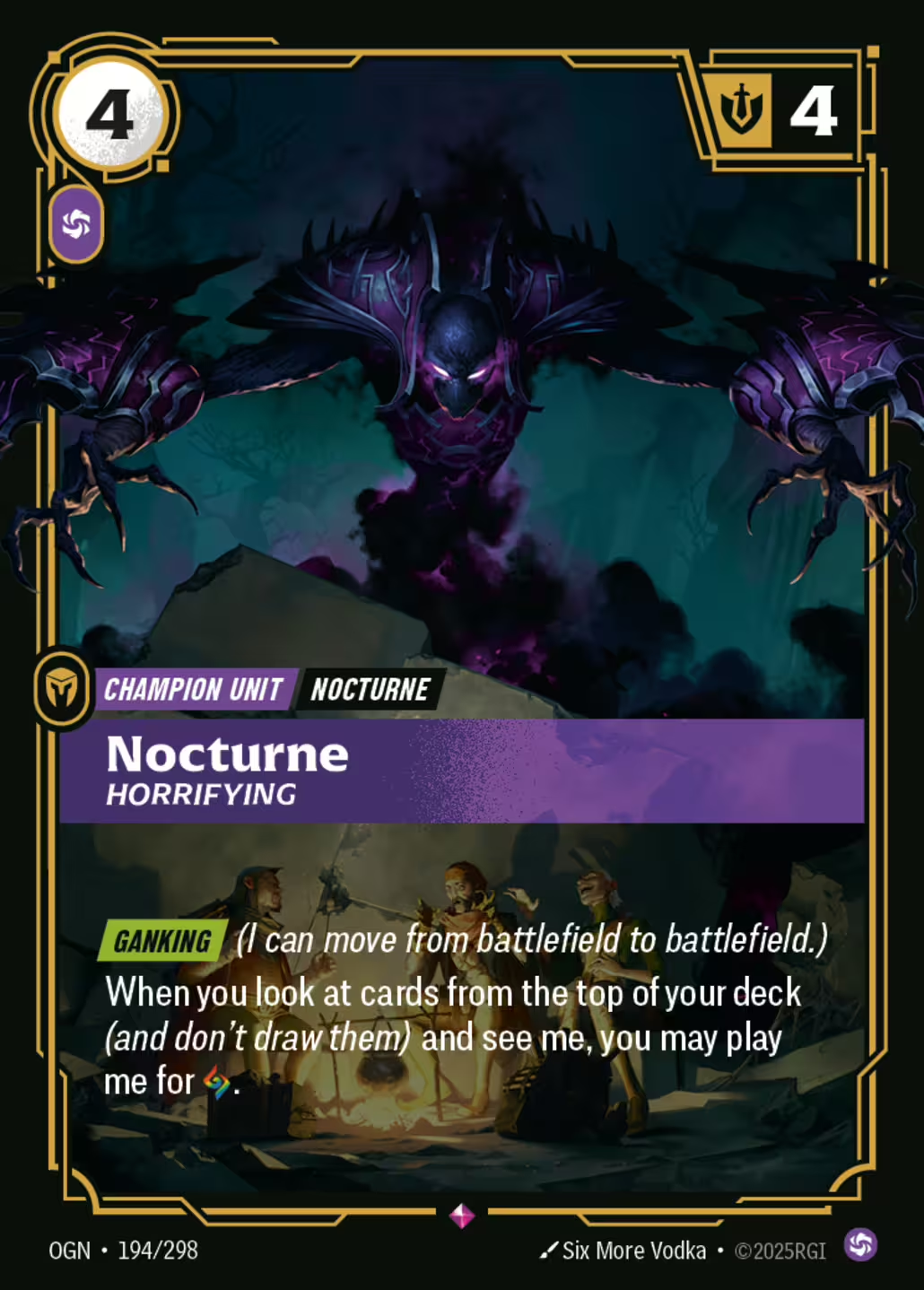
Nocturne, Horrifying
OGN #194
Erratas & Clarifications
Q: What about Dazzling Aurora? If I reveal Nocturne, do I get to play him and keep going?
No, Dazzling Aurora stops when it finds Nocturne. Nocturne is revealed, then you may choose to banish him or not. If you banish him, you can play him for [A] using his own ability. If you don’t, you can play him for free using Dazzling Aurora’s ability (probably better, but you do you). Either way, you revealed a unit, so you don’t keep going.
Q: So if Promising Future resolves and one or more players choose to banish Nocturne from the cards they looked at, what happens?
As you go around in turn order and each player looks at their top 5, they can choose to banish one or more Nocturnes before they banish a card with Promising Future. Any such Nocturnes will go on the chain as pending items before whatever that player chooses with Promising Future. They’ll remain pending through the whole process of resolving Promising Future, then at the appropriate point they’ll be fully placed on the chain and (because they’re units) will resolve immediately.
Q: If I reveal multiple Nocturnes, can I play more than one? What if all 3 of the cards I look at for Stacked Deck are Nocturnes and I play all of them?
Yes, you can play more than one Nocturne at a time this way. If there aren’t any eligible cards left for the original effect you were resolving, any further instructions will be ignored. So if you reveal Stacked Deck, see 3 Nocturnes, and opt to banish and play all of them, you won’t put any cards into your hand, nor will you recycle any cards. You will, however, have 3 Nocturnes.
Q: So how exactly does this ability work?
The process starts as you look at or reveal cards from the top of your Main Deck due to an effect. Let’s use Stacked Deck as an example. You play Stacked Deck and look at the top 3 cards of your deck. Nocturne is among them. You now get to choose whether to banish him or not. If you choose to banish him, you immediately begin the process of playing him from banishment, placing him on the chain as a pending item. Then you continue resolving Stacked Deck. There are only 2 cards left of the original 3; you’ll choose one to put into your hand and recycle the other one. Then, since Stacked Deck has finished resolving, you’ll finish the steps of putting Nocturne onto the chain from banishment, paying [A] (that’s one power of any type) instead of his base cost. As usual for units, he’ll resolve immediately and enter the board exhausted. If you weren’t able to play him for any reason, he’ll just stay banished.
Q: OK, so what about Nocturne? How does his ability work? Is it a triggered ability? Can I use it if I “reveal” him, or only if I “look at” him? Nocturne has a few problems we’d like to address.
His ability is worded like a triggered ability (“when”), but it can’t really work like one. By the time a triggered ability could go on the chain, be reacted to, and resolve, you wouldn’t be looking at Nocturne anymore. He has the same problem that the above cards do: you’re trying to play a card from a deck (in this case, Nocturne himself), and it’s hard to put him back there if you try to play him but can’t for some reason. He is intended to be usable any time you’re looking at the front faces of cards from the top of your deck, whether the effect in question says to “look at” them or “reveal” them. The rules will be changed to clarify that last one—they will now explain that to “reveal” means the same thing as “allow all players to look at.” Nocturne is receiving errata to solve these problems and bring him in line with his intended function. This errata makes it clear that this ability is not a triggered ability, and it uses banishment as a holding zone. It also specifies that revealing and looking both count; although we are handling that part at the rules level, we also want card text to reflect it unambiguously.
Le texte de la carte se lit désormais :
[Ganking] (I can move from battlefield to battlefield.)
As you look at or reveal me from the top of your deck, you may banish me. If you do, you may play me for [A].